The FPA would like to clarify the obligations and guidelines of members receiving TV pool assignments in respect of the procedure for distributing the pictures.
- In war zones only: unilateral stand ups will be allowed, but great care must be taken to minimize reporter presence in general coverage.
- A bulletin of basic editorial information should be distributed by e-mail, or other acceptable means to the FPA for general distribution to members as soon as possible.
- The pool material must be made available as soon as the facility finishes and before the material is broadcast by the member entrusted with the pool obligations.
- The pool material must be made available to all members via the agencies, and JCS in the usual way, at the expense of the member entrusted with the pool obligations.
- The FPA will inform members of the availability of pool material as soon as the facility finishes.
DENIAL OF ACCREDITATION TO PALESTINIANS
In late 2001, GPO director Daniel Seaman announced that they would cease the decades-old policy of providing Israeli press credentials to Palestinian reporters working for the foreign press. The consequences were dire: whereas in Israel, these GPO cards are used primarily for access to events, in the West Bank and Gaza – particularly for Palestinians – they are absolutely crucial for moving around and for carrying out the basic functions of a journalist.
At the time when the cards of Palestinian foreign press staff expired en masse on Dec. 31, 2001, the Israeli army held positions surrounded most of the autonomous Palestinian cities of the West Bank. Without the cards our Palestinian staffers could no longer pass roadblocks, and were essentially confined to their home towns. The problem worsened dramatically three months later when Israel, responding to a wave of suicide bombings and other terror attacks, invaded and occupied most of the West Bank’s cities – where Israeli troops remain to this day. This means that the Palestinian staffers encounter Israeli troops constantly, and the result – especially with photographers and video crews – is almost always interference as soon as the troops find that these people cannot produce GPO cards. Sometimes it is confiscation of materials, physical abuse, and even detention or arrest.


The local bureau chiefs and the overseas managements of the major media organizations strongly protested the policy, and in Feb. 2002 the GPO reached an arrangement with the FPA whereby a restricted number of Palestinian journalists would be given GPO cards labelled “territories only” (to prevent their use for entry into and work inside Israel). Despite a written promise from Seaman, this agreement was never carried out, and the GPO – with the support of the Prime Minister’s Office – has disavowed it. Since then, Seaman has given numerous Israeli media interviews in which he lambasted the foreign media as anti-Israel and argued that its Palestinian staffers are all propagandists with excessive influence over coverage. The FPA, of course, refuted such charges as grossly unfair generalizations.



Reuters is now appealing the denial of press accreditation to Ramallah-based TV producer Ahmed Seif to the Supreme Court. If the ruling is in favor it could undermine Israel’s ability to continue the policy.
DENIAL OF VISAS TO FOREIGN TV CREWS
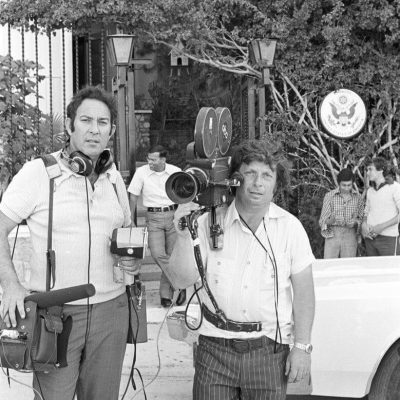
Concurrent to the crackdown on Palestinians, the GPO changed the policy that until then had allowed easy access to Israel – and hence the West Bank and Gaza – for foreign TV crews. Such crews had hitherto been recognized as journalists, and as such “fiduciary,” meaning their employment here, like that of reporters and photographers, was not a labor issue but rather a basic right of the foreign media – a right, incidentally, recognized in the GATS agreement to which Israel is (with reservations) a signatory. Under the new GPO policy these crew members became “technicians” whose presence requires explicit work permits from the Labor Ministry. The issue became mired in utterly false but politically potent claims by the Israeli camera union that the foreigners – who altogether number fewer than 20 – are taking away jobs from Israelis at a time of economic crisis.
We argued that beyond our basic right to hire whomever we deemed suitable, there was an urgent practical need for the foreigners to be here in order to cover the Palestinian areas – where Israelis face grave risks and Palestinians, as we have seen, are severely impeded. Furthermore, the fact that Israel created a situation whereby video coverage of the territories became extremely difficult, while its officials regularly attacked the foreign media as biased, strongly suggested to many that what was happening amounted to a deliberate governmental obstruction of our work – which would be an utter violation of the freedom of the press and democratic norms that Israel purports to hold dear.
FPA chairman Dan Perry took this argument to the Knesset Foreign Affairs and Defense Committee, to President Moshe Katsav and to a host of Cabinet ministers. After more than a year of obstruction – in which the Labor Ministry awarded not a single work permit to a videographer – a meeting was held on March 23rd between Perry and deputy FPA Chairman Tami Allen-Frost and Employment Service director Avner Ofri – in which the FPA made clear that it was prepared to immediately take the issue to the Supreme Court. On April 7, the Labor Ministry announced that it would begin providing permits to foreign cameramen. But within days the decision was overturned by the Industry Ministry, which in the new government was given ultimate say over the issue. Perry met on July 1 with Raanan Dinur, director of the Industry Ministry; also present were Seaman and the Israeli union representative. Dinur ruled in favor of allowing foreign TV crews in again, with some restrictions. Implementation, however, has been halting: to date not a single visa has been issued, with the GPO citing bureaucracy and a dizzying variety of complications. |