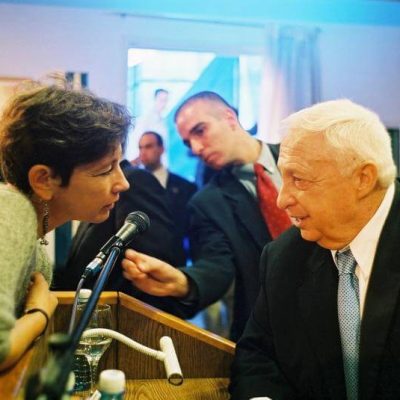
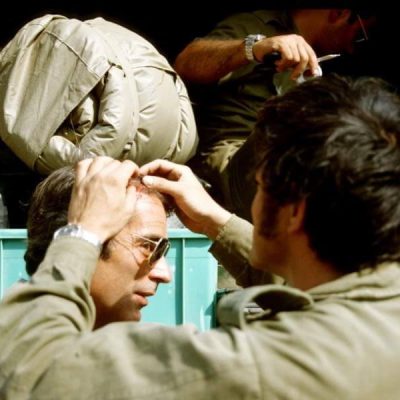
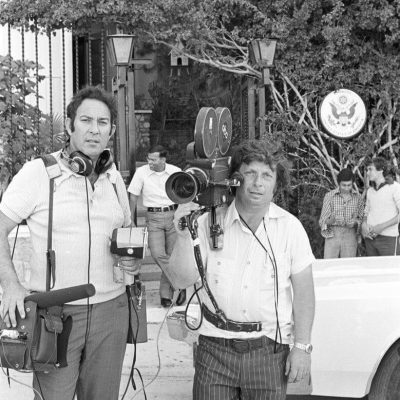
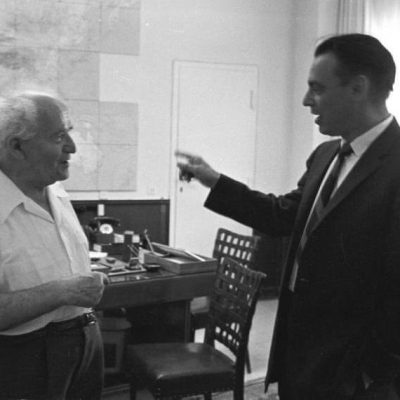
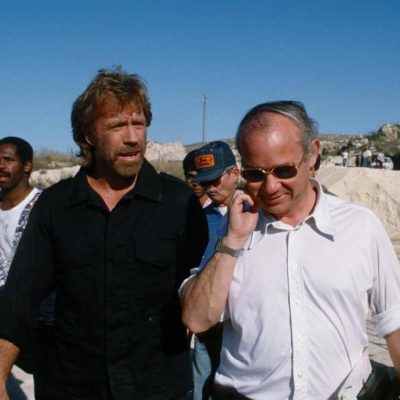
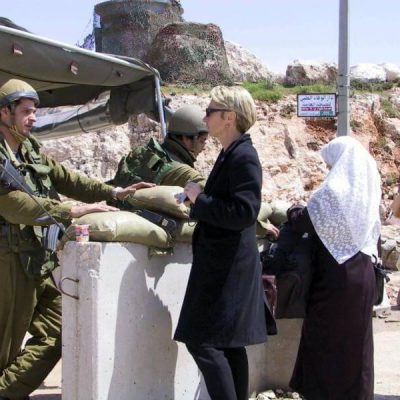
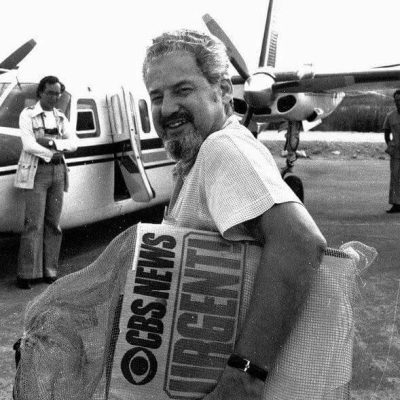
See Historic Gallery for photographs of FPA members in action - click on photo to see enlargement and caption !
Fifty years of reporting in the Middle East : FPA Members – past and present – record their memoirs and impressions. Articles appear in historic order.
More contributions are most welcome ! Contributing writers so far:
Francis Ofner, Dan Scemama on Andre Scemama, Marlin Levin, Richard Oestermann, Jay Bushinsky, Colin Bickler, Eric Silver, Robert Slater, Renee Singer, Stephanie Genkin, Charles Sennott, Eric Weiner, Dan Perry, Jamil Hamad, Matt Rees, Sa’id Ghazali.
THE BIRTH OF THE FPA IN ISRAEL
Francis Ofner was Israel correspondent for the (London) Observer in the 1950's and founding head of the FPA.
It was almost a half-century ago that 32 members of the foreign press gathered at Tel Aviv’s seaside Armon Hotel for their inaugural luncheon.
Israel was a different country then. Its society and economy have grown, as have its problems -- and so has the FPA. But our mission remains much the same as it was back then, on May 14th 1957.
Here’s something else that hasn’t changed: Shimon Peres was the guest.
The birth of the FPA – no offspring of love – can be traced to an altercation that focused my mind some two years before.
Interviewing David Ben-Gurion for the London Observer, I heard the prime minister lash out at Britain’s Anthony Eden for suggesting Israel allow Egypt and Jordan a corridor through the Negev. It would have strengthened then-enemy states and cut off Israel from its outlet to the Red Sea. Ben-Gurion was outraged. “Both Britain and Russia were now pursuing policies which might lead to the destruction of Israel, though for different reasons…” he said.
After the meeting an official who sat with us asked to see me and, in my hotel room, went over the article with dismay. “You cannot send it this way,” he said.
“What do you mean ? Did he not say that?”
”He did. But he was excited. You have to tone this down.”
It was not my task to censor the Prime Minister, I replied.
“You know, I can arrange that you be arrested!” the official snapped.
I sent the story unchanged, and the front-page headline could not have pleased the official: Israel Accuses Britain: “Buying Arab Friendship with our Dismemberment.”
News agencies picked it up, leading papers in Israel to do the same, causing uncomfortable questions in the Knesset. Was he misquoted? Ben-Gurion was asked. From the press gallery I listened with interest.
“I was correctly quoted,” the Old Man replied. “This is what I said.”
And I was not arrested – but the need for an association to safeguard the rights of the foreign press and represent its members was becoming plain.
Events soon distracted our attention, but by early 1957, the Sinai War story was cooling down and felt the time had come. I began campaigning among colleagues to cease fighting the Goliath of Israeli officialdom in isolated separate battles and join forces instead.
We needed a Founding Committee of colleagues to help me push the idea. If you wanted your group to carry weight in Israel, you had to appear either in large numbers or be supported by a political party. We were neither. And not all of our colleagues approved from the start either.
The head of Reuters bureau in Israel, Arie Wallenstein, was one who was doubtful.
“I do not need it. Neither do you. Both of us have open doors to whomever we need.”
Representing Reuters, he may have been right. But others needed it without a doubt. And after some persuasion, Wallenstein became one of the most active organizers, even served as chairman in 1967-68.
The second colleague I appealed to was German newspaperman Rudolf Kuestermeier. He had spent most of Hitler’s rule in Nazi prisons and concentration camps. When Britain’s forces freed him from Bergen-Belsen, they appointed him editor of “Die Welt.” Though offered high positions in his own country, Kuestermeier preferred to report from Israel. I saw that he was moved by my proposal.
The third recruit was Fabien Lacombe of Agence France-Presse, who had fought in the French underground during the World War II. He agreed without hesitation as well.
Then came Eliahu Salpeter, an Auschwitz survivor, then of the Jewish Telegraphic Agency, and later of Haaretz.
This founding committee did its job, and the Constituent Assembly met in Tel Aviv’s ZOA house to form the first Foreign Press Association in Israel on May 9, 1957.
A set of proposed rules were discussed and voted upon paragraph by paragraph. A system of elections – still in place – was established.
And the following Board emerged: I was elected chairman (or, as we ambitiously called it then, “president”); Lacombe vice-President; Golda Zimmerman (London Jewish Chronicle) Honorary Secretary , Salpeter, Honorary Treasurer. Roy Elston (The London Times), Seth S. King (The New York Times) and Arye Wallenstein (Reuters) were the three additional Board Members chosen by the Assembly.
The names, addresses and telephone numbers of the 32 founding members was published three weeks later. This list was sent out to Knesset members, government offices, spokesmen, Chief Rabbis, Israeli newspapers add major civic organizations – another practice that remains.
Interestingly, not a single photographer appears on the list. I believe the reason was that none of them worked predominantly for the foreign media at that time – a condition for membership.
We decided not to start our opening function with a heavyweight public figure but rather with a promising young official. The choice fell on Shimon Peres, then Ben Gurion’s Director General in the Ministry of Defense. He became internationally known the previous year. Peres had helped secure French “Mystere” fighter planes which were critical to Israel’s success in the Sinai campaign. The lunch with him was a success, and we agreed to hold similar meetings every month if possible.
The very next month our guest was the prime minister.
Unlike more recent times, journalism was not yet considered a coarse occupation. Since Ben-Gurion wrote occasional commentaries in the Labor Party’s periodicals, he introduced himself to the one month old FPA as “a journalist” as well.
As chairman, I welcomed our “colleague” and added: “We feel honored by the Prime Minister’s statement that he belongs to our profession. In writing he indeed surpasses many of us. In one thing however he does not share our fate: he is not disturbed by the censor…”
BG did not react – but the chief censor, Col. Walter Baron, whom we also invited, did. He smiled, and invited me the same week to hash out our differences. Then, as now, dealing with Israel’s military censor is a delicate affair.
Normally we battle for the right to publish – but I also appreciate the circumstances that may make it sometimes essential. For those of us who went through World War II, it is frightening to think of the consequences had television existed then and shown the American public the brutal images from the front. President Roosevelt might have faced pressure to pull out. Nazi Germany could have won. There would probably be no FPA in Israel – or Israel.
Arranging the luncheons, then as now, was often a delicate business too, and it sometimes took unexpected turns.
Since we had invited diplomats to speak to our lunch meetings I did not want to discriminate against the Russian ambassador. I asked Sergei Losev, correspondent for TASS, to ask his ambassador to be our guest.
A fortnight later, Losev invited me to lunch – at a restaurant was outside Tel Aviv on the way to Ramleh. It appeared he did not want us to be seen together. And instead of talking about his Ambassador, he tried to recruit me as a Soviet spy.
His failure in this effort was forgiven, it seems: after leaving Israel he became the head of TASS.
Beyond the meetings, the usefulness of the FPA was evident enough. Our working facilities improved; government communiqués and other news sources reached us quicker, disputes with censors and other officials became less arbitrary. At a time when bureaucracy restricted many aspects of people’s lives, the FPA was able to secure special foreign currency rates, exit visas and the like for its members.
During the 1977 peace talks between Israel and Egypt, for example, Foreign Minister Moshe Dayan decided that holders of Israeli passports – which included some of our correspondents – would be blocked from traveling to Egypt. FPA Chairman Gideon Berli of DPA encouraged some members to appeal to Israel’s Supreme Court. Yuval Elizur (Washington Post), Shabtai Tal (a press photographer for the German media) and Hazy Carmel hired a lawyer and won the case.
The FPA then hired an Arkia plane and flew with about 55 members to Cairo. It was the first Israeli plane to land in Egypt in the 4,000-year relationship between the two nations. Begin’s was the second.
The FPA now has more than 300 members, and the problems of the press in Israel, and the West Bank and Gaza, and perhaps more complicated than ever. Recent chairmen had had to handle a rambunctious, sometimes egotistical crowd.
Recently, the position was occupied by Conny Mus of RTL (1990–95); Nick Tatro of AP (1995–99); Howard Goller of Reuters (1999– 2001), Dan Perry of AP (2001-2004) and Andrew Steele of the BBC.
My role in founding this organization was an exciting and rewarding episode on the civic side of my professional life. But in truth, I would be ready to trade our international media importance for the situation longed for by Moshe Sharett, Israel’s first Foreign Minister, who told me:
“I look forward to the day when the State of Israel will be mentioned in the international media as often as Denmark.”
Andre Scemama
Noted Israeli journalist Dan Scemama writes about his father, Andre.
He decided that we were not spies. He decided that we worked as as anyone else did and served our readers and viewers the world over. He had differences with Teddy Kollek who was the Director General of the Prime Minister's Office. At the time, Teddy Kollek passed a regulation according to which whoever worked for the foreign media was a spy.
Andre Scemama resigned from his secure position as head of the Foreign news desk of "Kol Israel" ( Israel Radio) and, like the rest of us, became a foreign correspondent for Radio France, Le Monde, and French TV. He was one of the founders of the Foreign Press Association with the aim of doing battle against the authorities and later despite all difficulties, he became a full-time correspondent for all three outlets.

In 1977, with the arrival of Anwar Sadat in Israel, two co-workers at Le Monde turned on him, claiming that his reporting lacked objectivity and that there would never be peace with Egypt. He resigned from Le Monde, once again fighting the lone battle for both freedom of speech and against self serving colleagues.
Andre Scemama passed away at an early age in 1982.
HOW THE TIME NEWS BUREAU WAS BORN
Marlin Levin was a TIME-LIFE correspondent from 1958 to 1990, and FPA chairman for 1972-1973.
September, 1958. The phone rings at the city desk of “The Jerusalem Post” in Jerusalem.
“Roy Elston here.”
“Yes, Roy,” I reply.
“Marlin, I have to leave tomorrow morning for London.
I should be away for no more than a month. I would like you to fill in for me for TIME.”
“Sorry, Roy, I am over my head in work. Besides the POST, I am stringing for ABC, the Daily Mail and I am behind on a few pieces I am doing for a New Jersey weekly and a local monthly. And the holidays are coming up. Try Al Rosenfeld (NBC); he might be able to help you. Have a good trip.”
7 a.m. the following morning. The phone rings next to my bed. Half asleep I reply.
“Marlin, Roy here. I am on my way to the airport and I can’t find Al. Please take the TIME cable address. You need not do anything unless they cable you. They are not very much interested in Israel so you won’t have much to do. The cable address is TIMEINC MONTREAL.”
“Alright, Roy. But come back quickly. By the way why the sudden trip to London?”
”Monica has run off with the British Consul and I am going there to bring her back.” Monica, who had been the stringer for TIME, was Roy’s wife.
“Make sure you’re back within a month” is all I could say after absorbing the shock.
Next day, a cable from TIME requested coverage of an archeological dig near Beersheba. As luck would have it, I had a free day, so off to Beersheba I went in a taxi. Back by evening, I knocked out a story and took it to the censor, then the post office.
Three weeks later a letter came from TIME, New York, with a copy of the story as it appeared and a thank you note with a check.
It took me only a few minutes to understand that the generosity of that check for one day’s work, compared to my monthly POST pay, was not to be ignored. Logic demanded that I offer TIME more stories from Israel. Back of the book stuff. To my surprise, few suggestions were rejected. Israel had become the new boy on the block.
The editors’ appetite for stories from this country became so great that I had to have help. My colleague, Ruth Cale, who filed to a British paper, agreed to handle the stories for which I had no time.
And I asked David Rubinger to handle the picture requests. A news bureau was thus created. Gradually, the three of us would meet routinely to discuss story ideas. Many suggestions—based on the findings of Israeli researchers in a dozen different fields—were bizarre enough to whet TIME editors’ appetites for more: “What Noah’s Ark Really Looked Like,” “Sowing Wild Oats,” “Fire-Proofing Wood.” It became apparent to us that the editors were as interested in these feature stories as in the routine political items.
By the end of 1959, our bureau, one of the first foreign news services to be headquartered in Israel’s capital, was one of the busiest in the entire TIME-LIFE news network; in fact, in the entire world with the exception of the bureau in Washington.
I was so busy that I had to quit the POST, but took a room in the POST building on Hasolel Street for the TIME’s first office in Israel. The Eichmann trial, the Pope’s visit, coalition crises, fighting on the borders, fedayeen forays, the Six-Day War when we had six covers in 10 weeks. Stories on religious controversies, archeological discoveries, medical discoveries, were flowing into TIME and LIFE. Israel was not a one-story country as it is currently. Interviews with Ben-Gurion,
Meir, Dayan. Kollek, Yadin—the mere mention of their names generated news stories. In one memorable week, America’s most influential newsmagazine published four articles generated in Jerusalem, causing the editor to send me a jocular cable: “Are you trying to make an Israeli magazine out of us?” But it was only in 1970, twelve years later, that the TIME-LIFE News Service staffed the bureau with regulars.
Roy Elston returned to Israel four years later—without Monica and was no longer interested in the job.
When I arrived in Jerusalem in September 1947 I was unaware that there was an under-employment problem for journalists.
Reporters who wrote English fluently were scarce. So American and British newspapers, uninterested in siting permanent staffs here, depended on reporters working for the Hebrew press. One Hebrew reporter wrote his stories for an English paper in longhand because he found it difficult with an English-language typewriter.
I had come under the GI Bill of Rights to study political science at the Hebrew University.
I had a university degree in journalism and had been a deputy editor at a New York daily. Four days after arriving in Jerusalem, a friend introduced me to PALESTINE POST founder and editor Gershon Agron who ordered me (that was Agron’s way) to begin work rewriting on the city desk. United Press bureau chief Eliav Simon got wind of my presence and asked me to cover the war for the wire service in Jerusalem, and London “Daily Telegraph” stringer Gavriel Cifrony, who was the reporter of the Tel Aviv daily “Haboker”, asked me to help him rewrite his stories.
Filing for UP was not easy. News items first had to be seen by the censor. They were then taken to the Post Office from where they were sent as telegrams or cables. The Post Office relayed the material over radio links. Copy was frequently garbled since most postal workers had a poor command of the language and often did not understand what they were typing. Breakdowns in the relays were common due to atmospheric disturbances, and that resulted in long delays.
In 1947 and 1948, when electric current was erratic in the city, we often filed through the U.S. Consulate, which had an independent power supply.
The wire services demanded from their correspondents that they keep their files short because postal charges were high. Because we were charged by the word, we resorted to Latin prefixes and suffixes to save the company’s money. Instead of the conjunction “and” we would attach the Latin “et” to the following word. We did not use articles such as “the” and “an”. Instead of quote marks we had to use the words “quote” and “unquote”. The word “stop” would substitute for periods, and “para” was not only used for “by” but also indicated a new paragraph. Here is how a cable to the United Press was sent in September, 1948:
07220 jerusalem radio reported tonight uninations consular true commission informed bunche paris arranging peace talks midarabs jews jerusalem stop rene neuville chairman truce commission scheduled leave proarab lines old city
tomorrow stop tis believed inconnection cumtalks end levin
For longer stories we would write “advances” or “mailers”, and hoped the postal service would get the stories to the U.S. within a week. We often looked for eagles”—persons flying to the U.S.—to take our copy to mail them there to the editors and thus save a couple of days.
It was a blessed the day when telex became available.
WISTFUL VIGNETTES
Richard Oestermann, correspondent for Aller Press Copenhagen still lives and writes in Jerusalem.
Way back in the early part of the roaring 1960's, when I landed in Israel for good after several short visits as a roving reporter for Scandinavian newspapers, I joined the FPA, which at the time had Al Rosenfeld, Bureau Chief of NBC Radio, as its chairman.
I may be one of the first journalists who became a member of the Association, when it was only two years old.
In 1963, Al led a group of some 15 foreign correspondents on a tour to Eilat and along the Egyptian border. Several veteran FPA members were on the tour: Eric Gottgetreu, of AP, Paul Kohn, Aryeh Haskel and yours truly.
Another vignette which comes to mind from the early days of the FPA was the fire at the El Aksa Mosque on August 21, 1969. A deranged Australian tourist, Michael Dennis Rohan, sheep sheerer by profession, set fire to part of the mosque. I happened to be driving nearby and saw smoke billowing from the building.
I parked my car and rushed up to the Temple Mount, proceeding to the historic Holy Place. Its south-eastern wing was aflame. I saw a ladder and climbed onto the roof.
Another member of the FPA had the same idea: veteran press photographer Rolf Kneller. He followed me on the ladder to the roof, engulfed in smoke. Rolf took some pictures. I wrote down my impressions. There were some 20 Arabs on the roof, in a frenzied mood. Had they known who we were, they might have thrown us down from the roof. We climbed down the ladder, to relative safety.
Another flash of memory: Some 30 years ago, foreign correspondents in Jerusalem had a wonderful tradition. We met on Fridays in the early afternoon at the La Belle Restaurant, near Bet Agron, in order to unwind after what was usually a tough week. We drank beer and chatted about our bravados and looked into our glass bowl trying to predict what the coming week might have in store for us.
Now and then we saw Shimon Peres, with cronies, in a distant corner of the restaurant.
It was important for us to relax in between events, and many of us liked to let our hair down on Saturday night parties. There were three special party makers: Anna Ponger in her Haportzim Street roof apartment, Peter Philipps in his Shuafat home and me in my home in Talpiot.
There was music, now and then dance, much beverage and many more Arab colleagues. Those were the days.
SHADWAN ISLAND
Jay Bushinsky was the first Jerusalem bureau chief for CNN, WBC and the Chicago Daily News, he was FPA chairman from 1968 to 1971. Jay still broadcasts daily for WINS Radio.
Israel was engaged in one of the most difficult and most underplayed military struggles in its history, the War of Attrition. It began, 3 months after a ceasefire that ended the Six Day War and lasted until mid-1970 when the U.S. brokered a truce.
There were attacks and counter attacks, almost every day. Gun duels across the Suez Canal, raids by Palestinian guerrillas based in Jordan reached Israeli targets in the West Bank and other operations. The Israeli armed forces retaliated, often sending task forces deep into enemy territory. But all of these actions were carried out without any foreign correspondents covering them.
The FPA board began a campaign for access to these combat situations: At first, the official reaction was negative if not suspicious and incredulous. But Defense Minister Moshe Dayan gradually began to understand the problem. The Board argued that the ban against eye-witness coverage by the foreign news media was to Israel’s disadvantage.
Every reprisal or retaliation inevitably was followed by atrocity stories from Egypt and other targeted countries. Finally the barrier fell when a task force was readied for an airborne assault on the Island of Shadwan at the northern end of the Gulf of Suez. Three journalists were allowed to go along – one of them, a foreign correspondent. This occurred Jan. 22, 1970.
As the then-incumbent chairman of the Foreign Press Association, I was chosen for this assignment.
It began in Tel Aviv at the home of one of the IDF spokesmen where I, as the FPA’s pooler, was told to don an IDF uniform. The next stop was Eilat, which was reached by an airplane that carried the entire team of paratroopers, officers and men and their weapons. The aircraft was a French-built Nord transport. It rained half of the way to Eilat and the water dripped into the cabin.
On arrival, there was a short operational briefing after which the soldiers and the three journalists boarded helicopters bound for Shadwan Island whose name means seagull in Arabic.
After landing at the top of the island’s spine-like crest, orders were given to march down to the lighthouse about 2 kilometers away where a British-made radar installation had been installed. En route, there was a small encampment of Egyptian centuries and a consequent exchange of fire that inflicted casualties on the Egyptian side. The Israeli troops kept going. We. the three pool correspondents (for the foreign and local news media), had been ordered to stay close to the task forces commander Brig. Gen.Haim Nadel, at all times. When the lighthouse came into view, a platoon was sent on a flanking movement that led it into an Egyptian mine field. That sortie cost the lives of two men. The lighthouse included a large complex and barracks that housed Egyptian soldiers. They were ordered to surrender, which they did. But to be sure they obeyed, a POW with the rank of sergeant was told to go down to the barracks to ensure they were empty. When he came back with word that they were, an Israeli combat team went down to inspect them and complete the island’s conquest. At that point, there was a burst of gunfire in one of the rooms. An Egyptian officer who had stayed behind, shot and killed one of the Israelis who was on that mission - a fellow officer. The Egyptian sergeant was given a smack on the back of his head and sent back to the POW compound.
Within less than an hour the we, the three correspondents (one from Israel
TV, one from the daily Lamerhav and I of the Westinghouse Broadcasting Co. and Chicago Daily News) were able to board a helicopter for the flight back to Eilat. The accompanying soldiers received a very sad welcome because of the casualties that had been sustained. Some of the women soldiers were in tears.
After the flight back to Tel Aviv, the entire foreign press corps assembled in Beit Sokolov. By then, the pool story already had been written, and submitted to the military censor for approval. There were no deletions. I, as the FPA pooler (in accordance with the FPA pool regulations) summarized the events and answered questions. My colleagues quickly dispersed to file their respective stories.
This was the first time in Israel’s history that a foreign correspondent who was not a citizen of this country had ever been permitted to accompany an Israeli military unit operating behind international borders. The precedent had been set. There were a series of other pools beyond the borders especially in Lebanon but after a while Prime Minister Golda Meir had second thoughts about this policy and decided that it should be cancelled.
DUTY CALLS: THREE TURBULENT YEARS WITH THE FPA
Dan Perry was the Associated Press Jerusalem Bureau Chief and FPA chairman from 2001 to 2004. He is now AP’s Europe and Africa editor in London.
It was with well-founded trepidation that we worked our way up the steps of the Government Press Office (GPO) building, that icon of officialdom nestled into an odd Jerusalem corner between noisy pubs, winding alleyways and a ragged patch of green a stone's throw from the Old City walls. Generations of foreign correspondents worked out of this building, but now most were gone, having abandoned it to the authorities that we – the board of the Foreign Press Association – had been invited to engage on this blustery October day in 2001.

A few months before, outgoing FPA chairman Howard Goller had asked me to volunteer for "election" as his successor. I was a new bureau chief for the Associated Press – but a little on the young side and lacking any history in the organization. Yet with Howard leaving for London the board members, his natural successors, seemed strangely happy to make way. Appeals were made to my sense of duty and soon I was installed.
Covering the Israeli-Palestinian imbroglio well is certainly a calling we all felt strongly about. But it's a complex business at the best of times, and representing the foreign press and its interests is no way to win a popularity contest with either side. Few are the conflicts where narratives and psychologies are so far apart – or where protagonists are both so accessible and (along with powerful diaspora supporters) so scrutinizing.
Palestinian Information Minister Yasser Abed Rabbo, honorary dean of the available-yet-critical school of media relations, called me up one day, seething over an application of the term "disputed territories" to the West Bank and Gaza. "You know very well these territories are illegally occupied," he bristled. When I countered by offering the definition of the term "disputed" he pounced, asking with deceptive innocence whether I lived in a house. To my affirmative reply he thundered: "Good! I want it!! Now it is disputed!!!" Such was always our lot in Jerusalem.
Now passions were truly bubbling over. The peace process had fallen apart, giving way to a time of violence and rage. For reporters the terrain had rarely been more dangerous.
The Palestinian Authority, under assault by the Israel Defense Forces, was losing control on the ground in its patchwork of autonomy zones. But while the foreign media's problems would increasingly come from armed gangs, official interference, when it occurred, could be thuggishly effective nonetheless.
On the day of the Sept. 11 attacks in New York and Washington, the PA leadership, aware of the PR damage caused by displays of support for Osama bin Laden, moved swiftly to suppress coverage, starting with a large celebratory rally in Nablus hours after the attacks. Reporting bans, detentions and confiscations spread to Gaza the following days.
We protested and a meeting was convened at Abed Rabbo's Ramallah office, where after a testy exchange we extracted promises that unimpeded coverage will be allowed. The bin Laden issue eventually went away, as did the howls from a coterie of disgruntled members that I stand down for having been too accommodating.
A few weeks later, I almost wished I had done just that as I sat in that Jerusalem building and heard GPO director Danny Seaman outlining the new foreign press regime.
First, Palestinians (with a few exceptions) would no longer receive GPO cards. Seaman's argument was that these were not residents of Israel, same as Bulgarians or anybody else. Of course the cards were necessary to cover the West Bank and Gaza because the army categorically demanded them of all journalists and made it impossible for anyone – let alone a potentially hostile Palestinian – to function in the field without them.
Theoretically the greater access and freedom enabled by the GPO cards could be abused, so we agreed to reduce their number to those Palestinians who needed them for coverage and as key members of staff. But there was little willingness to engage us. The issue has festered on for years as the FPA fought for Palestinians' ability to function as journalists and labored to persuade the army to at least honor their FPA membership.
Seaman's second policy change was in a way more shocking. Foreign TV cameramen would lose their classification as journalists, and as regular foreign workers would undergo the rigors of applying for work permits. The argument here was that these people were unfairly replacing Israeli cameramen.
It certainly seemed a red herring: we needed the foreigners for coverage of the territories, where Israelis were usually no longer willing to trek and often banned by their government from entering. In Israel itself, we were more than willing to employ Israelis, who were in any case less expensive. But most of the news was in the territories. We took our case as far as we could, meeting with union reps, Cabinet ministers, officials in the Prime Minister's Office and twice President Moshe Katsav, who tried in vain to help.
When more than a year passed without a single work permit being granted I appeared at the Knesset Foreign Affairs and Defence committee and asked a simple question: If Palestinians cannot have GPO cards and so are detained for carrying cameras, and if Israelis are not allowed into the areas, and if foreigners need work permits that are never granted, whom does that leave as video journalists in the West Bank and Gaza? Martians?
Uneasy compromises were eventually reached, but the issue continues to cause friction and dissatisfaction on all sides.
Other problems seemed to pile on by the day.
There were shootings at journalists –some of them fatal – and the FPA was at the forefront of efforts to ensure the cases were seriously investigated, the guilty punished and the lessons learned.
When the IDF invaded the West Bank in the wake of the Netanya Passover bombing of March 2002, the territory was closed off to foreign media, sparking an uproar over access. We managed, almost two weeks later, to get the severe restrictions on our movements lifted with the aid of attorney Gilead Sher.
As the violence increased and the bitterness grew, there were arrests and roadblock delays and occasionally confiscations of video and other material. At Ben Gurion airport, foreign correspondents were being hassled and delayed – so severely and routinely that it started looking like policy. There were hassles over getting armored cars into Israel and the territories and over whether Palestinians could drive them.
My favourite part of the job was hosting our frequent newsmaker events, which included leaders on both sides, Marwan Barghouti before his arrest and trial, the US ambassador, Shimon Peres calling for an Israeli-Palestinian-Jordanian confederation, a former Mossad chief – and also an Israeli Cabinet minister named Ehud Olmert who expertly sidestepped my interrogation about what led him to do a 180 on Israel's settlements and occupation and lobby Ariel Sharon to do the same.
But it is frustrating that for all the news pages we filled around the world, to this day few can agree on how to describe this period. This is as true of the general situation (Was the intifada planned and guided? Could it have been avoided at Taba?) as of the foreign media's troubles specifically (Was it the Israeli government's calculated intention to impede coverage from the territories?).
On the surface there was only violence and diplomatic stagnation, but more was happening than met the eye. On the Palestinian side Yasser Arafat's Fatah was losing its grip and the two-state solution its appeal as Palestinians concluded that time was on their side. Among Israelis, many were concluding – like Olmert – that their presence in the West Bank and Gaza was a liability that should end or wind down even without a peace deal.
Big things were to come: Arafat's death, Israel's Gaza pullout, Sharon's debilitating stroke, Hamas' rise to power, Iran and Hezbollah.
These I would follow from afar: in May 2004 I handed over to the BBC's Andrew Steele in a manner tried and true: with an urgent appeal to his sense of duty, a minimum of discussion that could only give him pause, and heartfelt hope for his success.
It has since been restored, from time to time, however grudgingly. During the 2006 Lebanon war, after much agitation, the IDF allowed the FPA eight television pools and two print pools. The campaign to cover combat situations, begun three decades ago, is not yet over.
CENSORSHIP
Colin Bickler, Reuters Chief Correspondent in Israel 1972-74, and member of the FPA executive and censorship committee
Foreign correspondents often have to worry about minefields. In the seventies one of the trickiest in Israel was the censor. In theory the path was clear; often it was mysterious and sometimes tortuous. Always it was a challenge, especially during the 1973 war.
One challenge was how far to push the parameters and if necessary plead innocence; another was how to write or broadcast between the lines. And frequently an anonymous source would appear in copy –“according to foreign reports”– which did not always work.
This was a frequent attribution for reports that Israel was developing its own fighter plane, initially called the Kfir later announced as the Gur. Everyone in Israel knew it was happening. This did not stop the Government denying it every time “foreign sources” reported it. And indeed the denials helped get the story out until it finally came clean after the ‘73 war. It was almost out on Independence Day that year, but the Government for reasons never shared with us, changed its mind at the last minute – literally after inviting selected photo-journalists to a “secret airbase” in the north to see it.
Incidentally, the base was so secret, it was hit by one of the first Syrian missiles of the ’73 war – a fact covered up by censorship at the time.
The rules were supposedly simple. They involved only matters affecting Israel’s security, normally military issues. In fact they covered a wide range, including economic issues. Guidelines were issued, sometimes in consultation with the Foreign Press Association, which had a censorship liaison committee. A lot was done on trust, at least for the major news agencies and supposedly responsible organisations like The Times, the New York Times and the major networks. Others had to submit all their copy for clearance, with the right of appeal to the Chief Censor.
I remember a Japanese correspondent thinking he had them beat by filing in Japanese only to get the blue pencilled copy back. Of course they had a Japanese-speaking censor! Wouldn’t surprise me if they couldn’t have found one who spoke Basque
As I said, the Agencies made their own decision on what needed to go the censor (on line), making their own interpretation and pushing the limits of the ambiguous guidelines. If one got it wrong, sanctions ranged from a slap across the wrist from the Chief Censor through being forced to submit every word of every story, to withdrawal of filing facilities for a period (which to be fair was rarely imposed). And even then, representations and a subtle suggestion tantamount to blackmail might work.

On one occasion United Press International, then a major player in the middle east, ran foul of the system, infuriating the Chief Censor by sending out what he thought should have been submitted. He ordered that all UPI copy must be physically presented in person at the Censor’s office for authority to send – a major sanction in a highly competitive world.
UPI’s pleas fell on deaf ears, until its smart Australian bureau chief announced a feature was about to appear analysing the work of the Israeli censor!
At the time, despite the FPA’s negotiations with the Censor, no one was not allowed to put in copy that a story was censored. The Chief Censor pointed this out to UPI, warning that sanctions could be worse. True, said the bureau chief, but I can’t stop my New York office writing its own story. The compromise: the order would last only 24 hours so long as the feature was not run. Honour was satisfied on both sides.
One could sometimes negotiate a form of acceptable words and one rule was usually honoured — anything said in an open session of the Knesset could be freely reported. That did not mean heavy pressure would not be exercised to stop Parliamentary indiscretions or embarrassment getting out.
For example: after the ’67 war, Israel held and controlled Egypt’s Sinai oilfields until handed back in the 1974 settlement. Israel was content to let the world think it was using the Abu Rudeis oil. Exactly how this worked was considered a “security “issue. Any suggestion – even from ubiquitous “foreign sources”-- that the crude was actually being sold off to pay for imports of products for refining in Haifa or already refined from Iran and South America was banned.
But then there was embarrassment of a stray Israeli test missile hitting an oil installation. Censorship went into full charge allowing only a brief, undetailed mention, until Defence Minister Moshe Dayan, either by accident or design, unexpectedly made a statement in the Knesset.
Was it a mistake? Who knows? We could not wait to get it on our direct wire. Within seconds the Chief Censor was on the phone to the Reuter bureau –obviously monitoring what was going out — pleading with us to stop the report. Asked why we should, he claimed Dayan was not supposed to make the statement openly!
“Please ask London not to issue it,” he said. “You must be joking” was the reply. We had broken no rule and surely the Minister of Defence – to whom the Censor in Chief answered – ought to know what he was doing. It was a mistake he pleaded. Not ours. Then, to a sigh, “well at least I tried” and he gave up.
They observed another custom. Any copy held up by censor, if it were finally decided to release it, was sent back to the correspondents in the order that the censor had received it
So that no competitive advantage was lost. Trouble was that often any advantage was lost by someone having released it outside the country or it was no longer timely. But it worked occasionally
We had a story, well sourced, that the PLO and Mossad agents were knocking each other off around Europe, in Paris, Italy and Spain with telephone-triggered explosions, sudden deaths in liftwells and the odd hit.
Then apparently they came to an understanding that it was not worth the candle and they stopped .We were not surprised that the Censor blocked the report, though we had not expected it to be totally strangled. Just as surprisingly, we were called some weeks later to say we could now release it, with a warning that it had some inaccuracies!
A bit of wheedling on what these were and story was released. Why? Who knows? But certainly the feature did not command the attention it might have done if it had been released earlier.
It could be burdensome under pressure of filing. Broadcasts too had to be submitted in advance and the line was usually monitored, though if the censor accepted there was nothing that was not in the accepted print version, it was allowed through on a clear line (otherwise it interfered with the recording at the other end). Use of the spoken word and certain emphasis could sometimes indicate better than the print version what was between the lines.
It is unlikely that everything was monitored. Indeed, during the ’73 war I managed a conversation on telex to a military airfield with an Israeli journalist who had been mobilised, without any apparent interference. But I was certainly puzzled why a prepared tape I was sending from a kibbutz near the Golan Heights to the Tel Aviv office, kept garbling. Then it dawned. “If that’s the censor please let this through to the office which will submit.” “OK” came the reply “but make sure it does.” I got a clear line and the office was phoned within seconds. Then, with some excisions the story was released on the wire.
At the time the FPA had a vigorous debate on being allowed to mention when copy was censored. The Censor was adamantly refusing until it was suggested our head offices would put a warning on all stories that correspondents were working under censorship. Not good PR. Reason prevailed and we were finally allowed to mention it in those stories that actually were censored.
As a footnote: The Censor was not always as well informed as one might expect from a branch of intelligence. When I came to leave, the Chief Censor called me in to say goodbye and to berate me for not letting on that I understood some Hebrew. He now realised I had understood their asides in the Liaison committee meetings! Tough! Then so had my FPA partner on the committee, Jay Bushinsky – it was all part of the game.
FPA AIRLINE
Eric Silver covered war and peacemaking in Israel and Cyprus for The Guardian from 1972 to 1983. He was FPA chairman in 1975. He now writes for The Independent
The first Israeli civil airliner to fly to Egypt was a BAC 111 chartered from Arkia by the Foreign Press Association towards the end of 1977. We flew to Cairo for the Mena House conference, the first negotiating (or, as it turned out, non-negotiating) session after Anwar Sadat’s historic visit to Jerusalem. The Israelis among us sang “Hevenu Shalom Aleichem”, the Hebrew hymn of peace, as we hit the runway. The crew members were more excited than we were.
Later, when Prime Minister Menachem Begin went to Aswan for a summit with Sadat, we chartered a Hercules from the Israeli Air Force. The Egyptians barred El Al and Arkia on the grounds that there was no civil aviation treaty. By some perverse logic, military flights were permitted.
The crew stayed with us for three days. When there was nothing much worth reporting, they flew us to see the massive rock-carved temples at Abu Simbel and the Valley of the Kings at Luxor. Not to be outdone, the Egyptians laid on a second Hercules to ferry the Cairo-based press corps. It must have been the first time Israeli and Egyptian military aircraft sat side by side on the tarmac.
The Israeli foreign press corps had pioneered the airline business three years earlier after the Turkish invasion of Cyprus in July 1974. Nicosia international airport, perilously close to the front line, was one of the first casualties. It was more than a year before Larnaca opened as an alternative. Nicosia is still closed.
The only way in and out of the island, for locals and firemen, was from Tel-Aviv to a sovereign Royal Air Force base at Akrotiri. The Brits made us welcome, even entertaining us in the officers’ mess. Soldiers and airmen turned a fast buck renting out their private cars at premium rates.
Those were the days before satellite phones, mobiles and e-mail. Until the situation stabilized, you couldn’t rely on local Cypriot communications. Film and tapes had to be flown backwards and forwards daily.
Dan Bloom, the cigar-chomping CBS bureau chief and former FPA chairman, cornered the market, chartering small planes of varying capacity from Israeli private airlines. It became known as Bloomair. His own network had first claim, but the rest of us could buy the spare seats. On one occasion, a wounded soundman was left behind because a correspondent had a deadline to meet.
I flew back to Tel-Aviv on the last Bloom flight. The nine-seater was grossly overloaded with television equipment. The pilot, an Israeli air force reservist, took off into a Wagnerian thunderstorm. The plane shook and dipped. We lost radio contact with both Tel-Aviv and Akrotiri.
Lenny Stone, an ABC fixer who was a qualified pilot, took over the mike, ever more desperately calling: “Charley, Charley, Charley.” When there was no reply, someone opened a bottle of brandy and handed it around. I said, “No thanks,” and passed it on.
Finally, Tel-Aviv came on the line and we found our way down. As we were leaving, a colleague praised my “bravery” in refusing the booze. Courage had nothing to do with it, I replied. If we were going to die, I wanted to know what it would be like.
FIGHTING FOR FREEDOM – THE FPA WAY
Robert Slater was a reporter in the Time magazine Jerusalem bureau from 1976 to 1996. He has written 29 books, including a biography of Yitzhak Rabin and numerous profiles of American business leaders. Slater was chairman of the FPA from 1987 to 1990 and continues to live in Jerusalem.
When I was told that the FPA was celebrating its 50th year, I was reminded of one of the pivotal moments for the organization 19 years ago, an event in which I was heavily involved as FPA chairman. The event began with an IDF decree.
“Starting tonight (March 28, 1988), Judea, Samara and Gaza will be declared a closed military area.” That was the chilling decree from IDF Spokesman, Brig.-Gen. Ephraim Lapid.
The first Intifada had been raging for four months, with some pretty violent interchanges between the Palestinians and the Israeli army. We foreign journalists wanted to be as close to the action as possible. The IDF decree meant that we could not do any first-hand reporting of the Intifada.
This then was the background for one of the Foreign Press Association’s first legal skirmishes with the IDF. It all seemed cut and dried to those of us in the FPA: Israel boasted of being a democracy; how could it prevent journalists from covering its biggest ongoing story?
At that time, I was all too aware of how difficult it would be for the organization to mount any kind of legal battle against the IDF and its pernicious decree.
In those days – and remember this is 19 years ago – the FPA really had no extra funds to finance a legal case before the Israeli Supreme Court. To mount a case, the FPA would have to appeal to its member organizations, especially the larger ones, to help foot the bill. Happily, the member organizations came through for the FPA.
There was virtual unanimity among our members that we should bring our arguments to the highest court in the land. And so, my colleagues on the FPA board and I decided to go to the Supreme Court as swiftly and aggressively as we could, however unusual a step it would be.
As exciting as it was to represent the FPA in Supreme Court action, it was equally thrilling for me to work side-by-side with a man who stood alone as one of the finest journalists and human beings to grace our lives – the late Michael Elkins, whose work for the BBC lent him a distinction that few others have matched. As FPA Vice Chairmen, Mike interacted with me around the clock as we prepared for the Supreme Court case. We never asked each other whether we had a chance to win. We just assumed that our arguments were so logical and so much a part of what true democracy was all about, that we would sail into the court and triumph easily.
Once we appeared at the hearing called by the Supreme Court, our optimism dissipated. For, the IDF’s attorneys had, as it turned out, an almost slam-dunk case: they simply argued that Israeli security was at issue in the instance before the court; and whenever the IDF invoked security as an argument for any of its actions, the courts almost always went along with the army’s arguments.
And so in legal terms, we lost the case.
That was of course a disappointment. But our “battle” with the IDF received widespread attention within the Israeli media. I believed at the time that the Israeli media coverage of our case more than made up for our loss in court. I predicted correctly that, while the army won legally, all the attention we garnered made us the actual winners; for we had won widespread sympathy within Israel for our contention that the press should not be barred from covering the Intifada in person.
Indeed, for the next three years, I was able to point out that, without putting out press releases reversing the original decree, the IDF kept the territories open to full media coverage, except on a few occasions. So who won the case and who lost?
LOCKED OUT OF THE PALACE
Renee Singer was executive secretary of the FPA from 1991 – 2001.
Prime Minister Yitzhak Rabin was going to meet President Hosni Mubarak in Cairo. It was February, 1995. There were no scheduled flights that day and it was decided by then-FPA Chairman, Conny Mus, that I should look into the possibility of chartering a plane to Cairo for FPA members.
After numerous telephone calls, an Arkia jet was chartered to fly from Ben-Gurion airport, wait for us in Cairo and return. Arrangements were made with the press office in Egypt to get the necessary permission from the Egyptian authorities. Cairo’s Israeli Embassy also was notified -- and we were off!
We received the requisite OK to land from the Egyptians. A bus was waiting for us at the airport to transport the 50 or so journalists to the talks in good time.
But when we arrived at the Itihadiya Palace we were stopped at the gate.
No, we were told, it was not possible for this group to join the other journalists already inside.
I soon realized that pleading with the Egyptian sentries at the gates was futile.
Because it was the middle of Ramadan tempers were short.
When I managed to talk to an official from the Israeli Embassy, he begged me to take the group away and thereby prevent a diplomatic incident. He promised to do his best for us and suggested that we return three hours later.
There is no need to describe the looks on the faces of the FPA members. Suffice to say that they were in shock. I was mortified, standing there on the sidewalk with a frustrated bunch of reporters who had awakened at the crack of dawn, paid $300, promised their respective outfits a story only to be told: “No dice!”
Some went off to find taxis to take them to hotels so that they could at least watch the event they had come to cover on TV. The others, well, I don’t know what they did. I managed to squeeze into a taxi with about three others and headed for the Cairo Hilton
When we did go back, the Egyptians were ready for us. I saw my own printed list in the hands of one of the guards. I was asked to identify each of the correspondents -- and one by one they were allowed to enter.
This episode proves that journalists should never give up.
Another event that comes to mind at this time was 10 years ago when the FPA was celebrating its 40th anniversary and had arranged a gala ball at the former Laromme Hotel in Jerusalem. It was to be a grand event. Entertainers were flown in from abroad. Colleagues and friends of FPA members were expected as were their counterparts from Jordan and Cyprus. In all, there were about 500 names on the guest list.
We were getting things ready at hotel for the event that was to take place the following day. Photographs provided by David Rubinger, were put up along with flags, and FPA memorabilia decorated the hall. The Chef had just come up to the management’s office to say that the food had been prepared.
But that morning there had been a terrorist attack -- a number of people were killed. The FPA Board felt that it would not be appropriate to hold the ball and decided to postpone. This meant new and complicated logistics. The hotel was sympathetic and waived all the costs as long as a future date was fixed. The entertainers were sent back home.
Postponing the ball reflected the frame of mind of the times here in Israel.
But, afterwards, terror attacks and suicide bombings became bizarrely almost routine, and events went ahead as scheduled -- weddings, parties, vacations and all.
DON’T TRY TO BLEND IN
Stephanie Genkin is a producer at CNN in New York. She was Chief Israel Correspondent for the (London) Jewish Chronicle from 1995-1998.
As a reporter, you never want to become part of the story. But that’s exactly what happened the day I went to cover the ultra-Orthodox demonstration aimed at shutting down Bar Ilan Road on Shabbat. “Get lots of color,” added my editor at the Jewish Chronicle before hanging up.
It was a hot summer Sabbath morning in August 1996. I put on a long skirt and a modest shirt with three-quarter sleeves. After all, I wouldn’t want to flash my fleshy elbows and trigger a riot among the city’s holy men, I joked with Sharon Moshavi, a fellow American reporter. One thing I had learned from years of covering tense situations in Israel: It was always better to try and blend in with the crowd.
I also didn’t want to offend anyone’s religious sensibilities to get the story. So with a small reporter’s notebook carefully stashed in the waistband of my plain, dark skirt I set out on foot to the road in question about a kilometer away.

At first the protest seemed small and listless. It was as if Jerusalem’s fervently religious were too drained from the heat to match the passions and anger of the previous week’s protest, when a few haredi protestors had hurled dirty diapers at Israeli police trying to disperse the crowds.
For several minutes, Sharon and I stood in the middle of the road, seemingly unnoticed, taking in the scene around us and silently making mental notes for the articles we would each file. An older man, perhaps a rabbi, motioned us over with an impatient gesture. Before hurriedly taking his own leave, he mumbled something in a low voice, thick with the accent of Eastern Europe. Sharon and I looked at each other puzzled. But it was already too late.
Before we could piece together the message, an angry crowd of men had gathered along the police barricades lining the road shouting insults at us in Hebrew, Yiddish and English. We knew we had to get out of there quickly, but doing so would prove to be difficult. We were hemmed in from both sides. The crowds had thickened and we had barely a narrow path by which to escape.
With my head down and eyes focused on the pavement, I grabbed Sharon’s sleeve and began leading us forward, hoping to pass the angry mob so we could bolt over wooden horses placed along the street earlier in the day to maintain public order and ensure the safety of all Jerusalem’s residents. But we had no such luck.
A hand reached out of the pack tugging at a lock of my dark curly hair; a man’s boot kicked from the side-line and landed solidly sole-down on my arm. I heard the guttural rustling of throaty fluids and knew that more than one kollel-aged pimply young man had aimed his spit at me. It was outrageous. All we had done was show up at a demonstration about the future use of a road one day a week. What in the world had made us the target of such hatred?
After many long minutes, we finally reached the end of the road. We crawled under the barricades, sweating and cursing, only to see our more sensible colleagues staring at us curiously. Many of them were in shorts, with pens and notebooks and even cameras in hand. They hadn’t tried to blend in. They hadn’t tried to be sensitive to local custom. And as a result, they weren’t black and blue, humiliated and seething with anger.
To add insult to injury -- quite literally -- an hour later a Canadian television reporter, with flaming auburn hair, fitted jeans and a gym-fit body that screamed “I’m not one of you” strolled straight down Bar Ilan road. She was blissfully unaware of our earlier harassment. A sea of black hats and fur shtreimels parted like the Red Sea for her. It simply didn’t make sense.
When I recounted the story to a friend who worked in the Prime Minister’s office he shook his head and said, “They knew you were Jewish and they knew you were secular. That’s why they attacked you.” Ignoring the obvious question – why attack us for being secular – I asked: “How did they know we were unobservant Jews even though we were wearing conservative skirts?” “Ah,” he said, “That’s obvious. Your hair wasn’t covered and you are too old to be Orthodox and single.”
COUNTRY OF BIRTH UNKNOWN
Charles M. Sennott was The Boston Globe’s Jerusalem bureau chief from July 1997 to September 2001. He’s now a special projects writer at the newspaper in Boston.
I have two sons born in the Holy Land, but only one delivered to the
Promised Land. Okay, let me explain.
During my stint as The Boston Globe bureau chief in Jerusalem, my wife gave
birth to two of our sons in places that, at least according to their US
passports, were not defined by the U.S. State Department as belonging under
the sovereignty of a nation.
Our son, Riley, was born in 1998 in Jerusalem at the Misgav Ladach
Hospital. His passport reads: “Place of birth: Jerusalem,
__________.”
And Gabriel was born in December of 2000 in Bethlehem and his passport reads: “Place of birth: West Bank, _______.”
Although no country is listed in either of the American documents, the punctuation and the blank space seemed pregnant with significance, suggesting that both places were soon to be determined as belonging to sovereign states. At that point the so-called “final status” issues of the sovereignty over Jerusalem and the borders of a future Palestine were still hanging in the air.
So my wife, Julie, and I were blessed with two healthy sons born in the Holy Land in two biblical cities that were, at least at this point in history, not internationally recognized as part of any sovereign state. It seemed fitting that both of these places so connected to redemption should remain outside of the parameters of the conflict that was raging in the



year 2000 over the establishment of national borders.
But as we returned to America five years later, we learned this was perhaps fitting in a poetic sense, but a bureaucratic nightmare in every other sense when it came to registering them in schools or obtaining their social
security numbers.
At least our oldest son, William, was born in Boston, Massachusetts, USA within the realm of what as members of Red Sox nation we hold to be the true Promised Land: Fenway Park.
JERUSALEM IN SOUND
Eric Weiner was National Public Radio’s Jerusalem correspondent from 1995 to 1999. He lives in Miami and is writing a book about happiness.
Nobel Prize winning psychologist Daniel Kahneman tells us that we all have two distinct identities. The Experiencing Self and the Remembering Self. It’s an academic way of saying what most of us already suspect: our memories are unreliable. In the Middle East, this can be a good thing.
During my four years in Jerusalem, my Experiencing Self was not too happy. The demands on my time were enormous, with no reprieve on weekends. My Experiencing Self experienced stress as I ran to cover conflicts from Gaza to Lebanon to Tehran. It seemed, at the time, that all hell was breaking out.
My Remembering Self sees things very differently. I have nothing but fond memories of “The Netanyahu Years”—memories that grow fonder by the day as I hear what it’s like now to cover the region. No more spur-of-the moment trips to Ramallah for pizza. No more leisurely overnights in Gaza. Yasser Arafat was a large-than-life figure, which made for compelling stories. The current Palestinian leadership is smaller-than-life. Of more concern, it is plural, and that is rarely good, for either journalists or those being lead.
Ahh, yes, The Netanyahu Years. Who would have guessed that we would look fondly at that time? But I do. The world seemed like a more innocent place back then. We still used the term “peace process” and with a straight face. Leaders like Jordan’s King Hussein still inspired respect.
And there was room for folly amid the tragedies. I remember covering a botched Israeli assassination attempt of Hamas leader Khaled Mashaal in Amman. Most of the details have faded from memory, but I clearly remember that one of the Mossad agents spilled a can of Coke on Mashaal in order to distract him. I don’t know why that one quirky detail lodged in my brain. I’m sure Kahneman and other psychologists have an explanation. All I know is that now, as I watch from afar as events unfold in the region, I am grateful for the human mind’s capacity for self-deception.
Our memories, of course, are linked to our senses. As a radio journalist, I remember in sound. It’s an occupational hazard. So while most of my colleagues, I imagine, recall what Jerusalem looked like or felt like during their tenures, I recall what it sounded like. If I close my eyes, I can hear the sizzle of a falafel frying at my favorite restaurant on Hillel street. I can hear the theme music for Kol Israel’s evening newscast. I can hear the thunderous booms that would occasionally fill the air, followed seconds later by the sound of my own heart beating in my chest as I craned my neck skyward, trying to determine if it was a suicide bomber detonating his charge or just the sonic boom of an Israeli fighter jet.
I can hear the crackle of the Israel soldiers’ radios in the Old City and the sing-song call of hawkers selling pita bread. I can hear the dull thud of tear gas containers propelled from guns. I can hear the pleas of “weyn al salaam” in Ramallah, and at Mahane Yehuda market cries of “lama, lama,” after yet another suicide-bombing. My favorite sound, though, is soft and barely audible. It’s the clink of ice cubes against glass and the swoosh of 16-year-old scotch, poured expertly and lovingly by Ibrahim at the American Colony hotel.
UNCIVIL CHECKPOINTS
Jamil Hamad, who lives in Bethlehem, has been Time’s Palestinian affairs correspondent for three decades and an FPA Board Member until 2004
Every day at the Israeli checkpoint going from my home in Bethlehem to visit TIME's Jerusalem Bureau, I see a sign that makes me laugh. Written in English, Hebrew, and Arabic, it says: "Peace Be With You."
It's a pretty sentiment, suitable for the birthplace of Jesus Christ. The sign, put up by the Israeli Tourism Ministry, may be written in Arabic script, but its message of peace is clearly not meant for Arabs — not for me, not for the hundreds of Palestinian laborers, school kids, businessmen, teachers, people going to see doctors, who must run the daily gauntlet of Israeli security checks.
A tourist who wants to go from Bethlehem to Jerusalem can make the journey by car in 15 minutes. I must go on foot and, depending on the mood of the young Israeli soldiers at the checkpoint, the trip can take an hour, two, three. Or sometimes, if there's a security alert, they simply close down the checkpoint to all Palestinians. Peace Be With You.
It's humiliating, and hard not to interpret this as a collective punishment against Palestinians. First, I walk into a long, wire mesh cage that runs along a 20-ft.-high concrete wall which, on the Palestinian side, is smeared with graffiti. On the wall, someone has painted a big pair of scissors as if to say: Cut along the dotted Line. If only it were that easy.
Then comes the Striptease, the long conveyor belt where you have to put all your belongings before going through the security check. Some days they make me take off my jacket, other days, my shoes or my belt. It's very frustrating, especially when you get behind a woman with lots of earrings and bracelets who doesn't know how the machine works — and there are hundreds of people pushing and shoving behind you. I've seen sick people desperate to reach a doctor, or people screaming because they're going to miss their airplane or connection to Jordan. But no matter how hard they shout, it never does any good.
After that, you have to show your ID and magnetic pass. There are five windows, but only one is ever open, no matter how many Palestinians are trying to cross through. The U.S. embassy people who perform periodic checks to make sure things are running smoothly at these checkpoints should really make surprise visits. Usually, the Israelis know beforehand that the Americans are scheduled for inspection. We can tell because that's when the soldiers open all the gates. But most of the time, there's only one soldier, and you have to be very patient and pretend to be sympathetic while he or she is on the cellphone for 10 minutes talking to a friend or a mother. Otherwise, if you try to hurry along the soldier in the booth, it puts him or her in a bad mood, and it can take a lot longer.
An Israeli general once told me, "Jamil, these checkpoints are nothing but an invitation for the terrorists to try another way." In fact, in all the years of crossing, I've never seen the Israelis catch a terrorist or a suicide bomber at the Bethlehem checkpoint. So what is the security value of this exercise?
Instead, the checkpoints have turned into places of humiliation by Israeli soldiers who are always shouting, and who assume that every Arab speaks Hebrew. We don't. So how can I understand it when the girl soldier is shouting at me so angrily?
Most Israeli soldiers don't speak Arabic, so they don't understand what the Palestinians are saying in line. I hear those voices. They think this process is a worthless humiliation. And they want to take revenge against the Israelis. How? By voting for their enemies, for the two Islamic resistance groups, Hamas and Islamic Jihad. This is how the Arab mind works: you are stronger, and you humiliate me. I'm weak. I don't have planes or missiles, but I do have the vote, and that's how I take revenge. I vote for your enemy.
If the Israelis consider every Palestinian, from a child to an old woman, to be a terrorist, then the Israelis have a problem that's not going to be solved by walls and security checks. Not all Palestinians are hostile to Israel. Most are interested in a peaceful life, in raising their children. A few believe in violence, but Israel can't punish all Palestinians just because of a few. At the same time, Palestinians shouldn't generalize about all Israelis based on a few settlers and extremists. But with these punishments at the checkpoints, it's very difficult. We feel humiliated. When I see that sign "Peace Be With You," I wonder: What kind of peace can this be?
“Quick, woman, go and get the Koran!”
Matt Rees was Middle East Correspondent for The Scotsman and Newsweek from 1996 to 2000, and Time’s Jerusalem bureau chief from 2000 to 2006. He now writes a series of Palestinian mystery novels www.mattbeynonrees.com
I have never been a religious man. Which is why I’ve always wondered why so many Palestinians want me to become Muslim.
I’ve been asked, quite formally, to accept Islam on three occasions during the course of my reporting from the Middle East. Two of them I consider to have been somewhat pro forma queries from deeply religious Muslims who simply viewed it as their duty to request that the stranger standing before them should join their faith. For example, a Hamas journalist in Nablus spoke with me at length and, on shaking my hand to say goodbye, put his hand to his heart and said: “I invite you to submit to Islam.” “Oh, well, thanks very much,” I said. “That’s rather nice of you. Cheerio.” Similarly, a Hamas fugitive in a Gaza refugee camp peremptorily offered me his thick, muscular hand with the same invitation, before disappearing up a stone staircase into the night, his M16 slung across his chest. I told him I’d think about it.
The third occasion, however, was a closer shave. I was in a Palestinian refugee camp in Jordan, interviewing the family of a young man who had gone to study at a religious school in Turkey, only to turn up dead on a battlefield in Afghanistan a few months later. The family didn’t want to talk about their son’s death, for fear of Jordan’s secret police, which was decidedly unamused by migrant jihadis amongst the Hashemite kingdom’s population. So my fixer and I decided to ask them about the boy’s Islamic studies, to draw them out, and then to try to move onto his possible reasons for fighting against the Americans in Kabul. I’m a good listener and I suppose I must have looked a lot more interested in Islam than I had intended, because the dead boy’s 60-year-old father began to get rather animated.
“Perhaps you will accept Islam,” he said.
“Well, perhaps,” I said.
He pushed the red and white keffiyeh back from his brow and rubbed a tear from his eye. “You will accept Islam and become our son, to replace the one who died.”
Oh, dear. “That’s rather nice of you…”
His wife, a thick set woman who had given birth many times, appeared excited by the prospect of gaining a son without going through labor. Or perhaps she was just happy to see her husband enthusiastic about something for the first time since their bereavement. The old man turned to her. “Quick, woman,” he said, “go and get the Koran!”
As the heavy lady puffed to her feet, my fixer whispered to me. “We have to get out of here,” she said. “They’re going to get you to make the declaration of faith on the Koran.”
“I don’t want to be rude,” I muttered. “But I don’t really want to be Muslim, either.”
She apologized, saying we had to be back in Amman before darkness fell, and promised that we would return soon. As we left, I saw the sad, generous old man’s silhouette in the blue light from his window and I almost felt sorry that I hadn’t let him convert me.
There was also the time an upper-class Palestinian woman wanted to convert me, so she could get me to marry her. But I don’t consider her to have been quite as disinterested in her motivations as the other three offers, so I don’t include her here.
PROPAGANDA AND IDIOCY
Sa’id Ghazali is a Palestinian journalist from east Jerusalem. He is writing his novel in Arabic, as an escapee from the mountains of pressure on his bones
A quarter of a century, a stormy experience in journalism, walking on a tight rope between two valleys, two chasms, two worlds. It made me somehow crazy. I admit, even by writing this piece, I am bored remembering the stereotyping, stressed with all the shallow reporting, overwhelmed by the stupidity.
My two worlds are not black and white. The angels and their faithful zealots do not dwell in one world and the bad Satan and his wicked followers do not live in the other world. The heinous angels with their militants and the good Satan and his respectable followers live in the two worlds.
The Israelis are propagandist and the Palestinians are masters of idiocy. There are many exceptions, but not among most of the decision makers. The exceptions are channeled into a narrow space, badly injured by the arrows of hate fired by their own people.
The journalists between the two worlds are the mechanical spectators. One day, they dance for a statement by Mr. Prime Minister who condemns Palestinian suicidal bombings in Israel, and the next day, they clap for a press release by Mr. Opposition Leader who opposes the Israeli army’s excessive use of force against Palestinians.
The truth is hidden in the belly of a huge whale. There is a need for a supernatural power to get it, recompose it and transform it into a dazzling statue under the sun.
The two peoples in the two worlds stupidly and mindlessly listen to the ode of lies and endlessly giggle and snigger, grumbling and complaining against the other side. The Israelis vigorously beat the drums of terrorism and the Palestinians endlessly chant the old song of occupation.
Absolutely, there no vision to get the two peoples out of this quagmire. The two sides have lost their common sense as they claim their positions are blessed and baptized by their supernatural deity.
The conflict, sadly, as a result of this continued relapse, goes on without a dawn of hope in the horizon and the temple of coexistence is crumbling.
The Palestinian world has already receded into ruin. Signs of devastation are also seen in the Israeli world.
My own world is not immune. I am schizophrenic. I could not love Israel for the sovereignty of rule and democracy and I could not hate Palestinians for their mess, stupidity and corruption.
Once, Palestinian militants beat up another journalist who has the same name as mine, for my “misuse” of meaningless national symbols. Once, also, Israelis misused me, by revoking my press card for unsubstantiated security claims, which Israel often uses illogically to punish the entire people and create more future enemies.
I thank my friends in the foreign media who backed me to get my press card through the Israeli legal system and the Foreign Press Association, which softly opposes the revoking of the press cards from the Palestinians who live in east Jerusalem and carry their Israeli identity cards.
This is not my best kicker. It’s a quotation from my novel, The Serenades of Mayhem. But it could be my best lead.
Sinbad is talking to himself: I have opened my own house of beauty, the Jinn women have been invited to get in, take off some of their clothes to alleviate their sins. I beautify them and they enchant me, but behave arrogantly, they dump me and refuse to make love with me in my royal bed, because I am just a barber.
TO THE CHAIRMAN AND MEMBERS OF THE FOREIGN PRESS ASSOCIATION.
The day after I was freed I did speak to Simon McGregor-Wood and thank him for all that the FPA did for me while I was being held captive in Gaza. I always intended to write to the Association and put my gratitude down formally, on paper -- for the record. And I am really sorry that it has taken me so long to do that. There is no good excuse. The truth is that I have been rather disorganised as I have tried to set about thanking the countless groups and individuals who deserved my gratitude for the extraordinary campaign that was launched around the world on my behalf. I came home to seven-thousand e-mails and many more letters, and the whole situation was a bit overwhelming and slightly chaotic, to be honest.
But there are few organisations to which I owe more than the FPA. The support of my colleagues in Israel and the Territories meant a huge amount to me. The journalists who I had worked with for years in Gaza were just amazing. On the fifth week of my captivity they actually fought with police as they tried to storm parliament to press for more action to free me. Amazingly, because my guards gave me a radio, I was able to hear about that protest, and about all the action that the FPA took in conjunction with the Palestinian journalists.
The BBC World Service reported on the FPA demo at Eres and the one in Ramallah. And in a moment of kindness, my guards let me see a bit of television that carried footage of that Ramallah protest. I also heard Simon on a number of occasions spelling out the FPA's outrage over what was going on.
Of course, while I was in the hands of my kidnappers I felt completely, and frighteningly isolated. I was certainly in the worst trouble of my life. I was afraid that I might be held for years, and there were times when I worried that I might not survive at all. And in those circumstances you can imagine how very, very important it was to know that my colleagues were behind me and doing all that they could. There must have been times when you stood holding banners or staging vigils when you wondered if you were really making any worthwhile difference. Well, I knew what you were doing, and I can assure you that you were indeed making a huge difference to me as I struggled to cope in psychological terms. I really am extremely grateful.
And all I can say in conclusion is that I hope that you'll all look after yourselves. I guess I learnt the hard way that our work in the Territories was even more dangerous than I fully realised.
All the very best,
Alan Johnston.
December 2007. |